



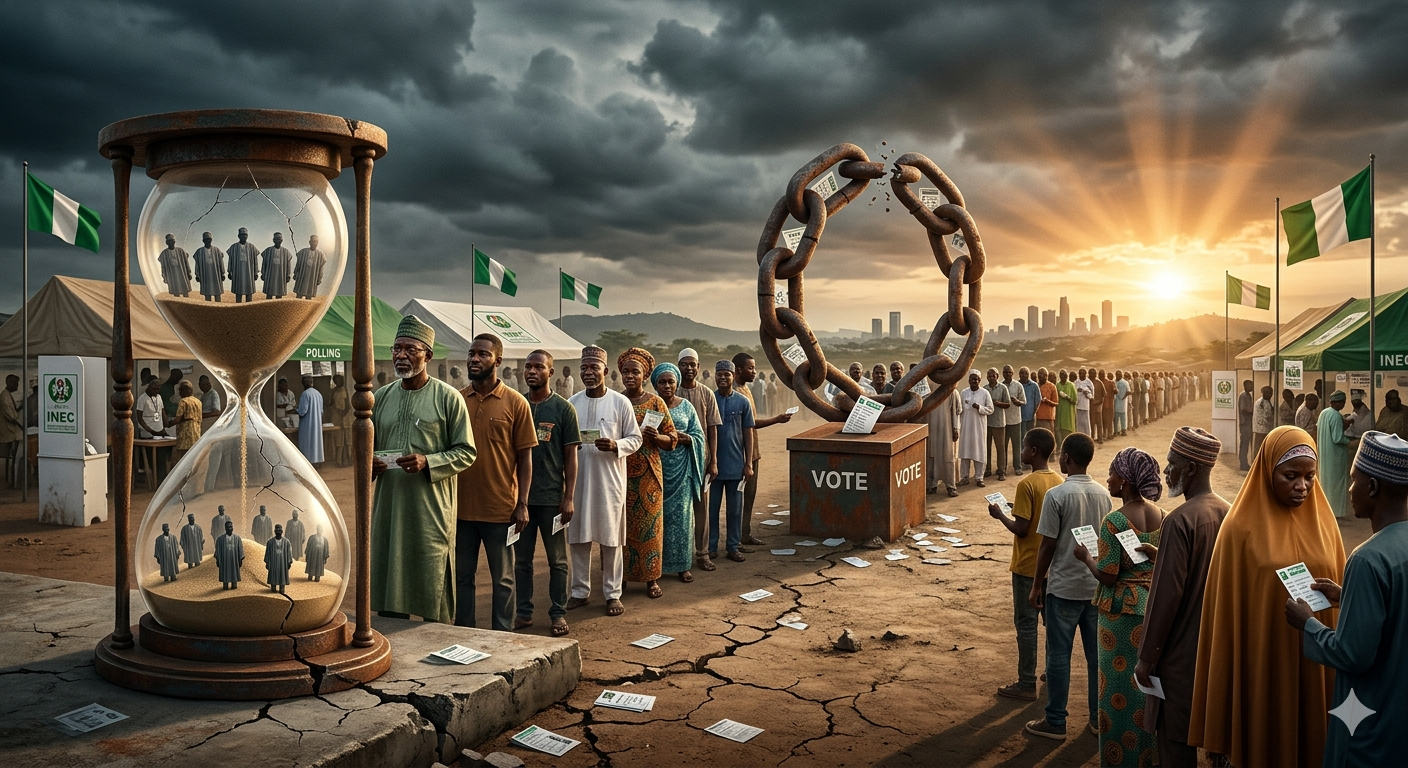
Every four years, millions of Nigerians stand in long queues, clutch their voter cards, and make a choice. Yet election after election, the faces change but the patterns do not. Understanding why requires looking beyond individual politicians — and into the structural machinery that produces them.
The Illusion of Choice
In the run-up to every Nigerian general election, the air fills with the familiar language of transformation. New branding. Fresh slogans. Carefully calibrated rallies in stadia packed with supporters bussed in from neighbouring local governments. And yet, if you stripped the names and faces from the campaign posters and asked a neutral observer to describe the candidates on policy grounds alone, the differences would be vanishingly small.
This is not a coincidence. It is the predictable output of a political system that has been engineered — whether consciously or through decades of inertia — to produce a narrow range of leaders. The pipeline from obscurity to electoral viability in Nigeria runs through structures that filter out almost everyone except those who already possess, or can access, three things: significant personal wealth, an ethnic or regional power base, and the patronage of an established political godfather.
Strip away any one of those three, and even the most capable, visionary candidate will find themselves stranded at the gates of the Nigerian political process — unable to secure a party ticket, fund a campaign, or mobilise the machinery needed to convert votes into actual electoral outcomes in an environment where result sheets can be as negotiable as market prices.
“The pipeline from obscurity to electoral viability runs through structures that filter out almost everyone except those who already possess wealth, an ethnic power base, and the patronage of a godfather.”
The Structural Filters That Maintain the Status Quo
To understand why the same type of leader keeps emerging, we need to trace the specific structural filters that shape Nigeria’s political process — from the decision to contest through to inauguration.
The first filter is the party primaries. Across Nigeria’s major political parties, primaries have historically been sites of intense financial competition rather than genuine ideological contests. The practice of delegate buying — where aspirants pay fixed sums to party delegates in exchange for their votes — has been documented across virtually all major parties. A 2022 civil society report estimated that delegate payments at APC and PDP gubernatorial primaries ranged from ₦5 million to ₦20 million per delegate in competitive states. For a typical gubernatorial primary with 1,500 delegates, the entry cost alone can exceed ₦20 billion. This single filter eliminates the vast majority of Nigerians who might otherwise make excellent leaders.
The second filter is campaign financing. Even after securing a ticket, the cost of running a competitive campaign for governor or president in Nigeria is staggering. Security votes for campaign rallies, the informal expectation of ‘stomach infrastructure’ — cash distributed at campaign events — the cost of parallel vote-collation systems, legal teams for inevitable election petitions: a realistic estimate for a competitive presidential campaign runs into several hundred billion naira. The practical effect is that presidential politics becomes the exclusive province of individuals who either have enormous personal fortunes or have made binding financial commitments to private interests that will, inevitably, shape their governance.
The third filter is the godfather system. In most Nigerian states, there exists at least one political heavyweight whose approval functions as a prerequisite for electoral viability. These godfathers — usually former governors, senators, or business moguls with deep party structures — do not merely endorse candidates; they frequently select them, fund them, and thereafter expect substantial returns on their investment in the form of contracts, appointments, and political protection. Candidates who emerge through this system carry obligations that precede and supersede any obligations they might feel toward the electorate.
The Role of Ethnic and Regional Identity Politics
Nigeria’s federal structure was designed to manage the country’s extraordinary diversity — 250-plus ethnic groups, a deeply complex regional history, and a north-south divide that runs through religion, language, economy, and culture. In practice, however, the federal character principle has been weaponised not as a tool of inclusion but as a mechanism for elite rotation.
At the presidential level, the informal but fiercely defended zoning arrangement — by which the presidency alternates between north and south — ensures that the pool of viable candidates is never the full range of Nigeria’s most capable citizens, but rather the most resourceful political actors within whichever geopolitical zone is deemed to be ‘next in line.’ Within that zone, further filtering by sub-regional and ethnic considerations narrows the field still further.
This system produces leaders who must satisfy complex ethnic coalitions before they can even address national questions. It creates a presidency that is, structurally, always in debt to the identity politics that produced it. The result is not leadership in the national interest — it is the management of competing ethnic claims dressed up in national language.
Importantly, voters themselves are not passive participants in this dynamic. Decades of experience have taught Nigerian voters — particularly in rural and peri-urban communities — that elections are transactional events. When a candidate distributes cash, food, or materials at a campaign rally, many voters do not experience this as corruption. They experience it as the only tangible benefit they are likely to receive from the political process, in a context where government services are absent and the rule of law does not reliably protect ordinary citizens from the powerful.
“Voters are not passive participants. Decades of experience have taught Nigerians that elections are transactional events — and the cash at the rally may be the only tangible benefit they ever receive from the political process.”
What Does “The Same Kind of Leader” Actually Mean?
It is worth being precise about what the pattern actually is, because the critique is sometimes misread as saying that Nigerian politicians are uniquely corrupt or that Nigerians are uniquely susceptible to bad governance. Neither claim is true or useful.
The pattern is structural, not ethnic or moral. The Nigerian political process consistently produces leaders who share a specific profile: they are almost exclusively male; they are drawn from a small network of established political families, business elites, and former military officers; they come to power owing financial and political debts that constrain their ability to govern independently; and they operate within a system where the primary incentive structure rewards the distribution of patronage over the delivery of public goods.
This is not because Nigerians are more corrupt than other peoples. Research in comparative politics consistently shows that institutional incentive structures, rather than cultural disposition, are the primary determinants of elite behaviour. Nigerian politicians behave as they do because the system rewards those behaviours. Change the system, and you change the incentives.
Five Structural Reforms That Could Break the Cycle
Breaking the cycle requires targeted intervention at the specific structural points where the filtering of leadership takes place. Five reforms stand out as having the greatest potential impact.
1. Mandatory transparent party primaries with independent oversight. The INEC-supervised direct primaries clause in the 2022 Electoral Act Amendment represented a significant step forward, but implementation has been inconsistent. Strengthening enforcement — including criminal sanctions for delegate buying — and requiring all parties to publish itemised delegate expenditures would dramatically reduce the cost of entering politics through legitimate channels.
2. Public campaign financing with strict expenditure caps and real-time disclosure. Nigeria’s campaign finance laws exist on paper but are routinely ignored. A functioning public financing system — where parties receive state funding in proportion to their previous electoral performance, and where all donations above ₦500,000 are publicly disclosed within 48 hours of receipt — would reduce the dependency of candidates on private interests and open politics to a wider range of aspirants.
3. An independent electoral commission with prosecutorial powers. INEC’s institutional independence has improved in recent cycles, but the commission still lacks the investigative and prosecutorial capacity to hold perpetrators of electoral fraud accountable in real time. An INEC with dedicated forensic audit capacity, the power to prosecute electoral offences directly, and funding insulated from executive influence would transform the credibility of Nigerian elections.
4. Civic education integrated into the national curriculum from primary school. The transactional relationship between Nigerian voters and politicians is not irrational given the current context — but it can be reshaped over a generation through sustained civic education that teaches the connection between voting behaviour and governance outcomes. This is not a short-term fix. It is a twenty-year investment. But without it, every structural reform risks being undermined by an electorate that has been taught, by experience, to expect nothing from the democratic process except the cash in the envelope on election eve.
5. Genuine devolution of fiscal power to local governments. Much of the incentive for capturing state and federal power in Nigeria flows from the extreme centralisation of revenue in the federation account. If local governments had genuine fiscal autonomy — real control over local taxes, budgets, and service delivery — politics at the local level would become more relevant to citizens’ daily lives, and the pathway from community engagement to higher political office would be more accessible to ordinary Nigerians without access to the national patronage network.
The Role of Civil Society and the Media
Structural reform does not happen in a vacuum. It requires sustained pressure from civil society organisations, a free and capable press, and an engaged citizenry willing to hold both politicians and reform advocates accountable for their promises.
Nigeria has all three of these in abundance — unevenly distributed, underfunded, and frequently harassed, but present. The 2023 election demonstrated that a new generation of Nigerian voters is capable of sustained political engagement across digital and physical spaces. The Obidient movement, whatever its ultimate electoral outcome, showed that the appetite for genuine political alternatives exists in Nigeria at scale.
The challenge for civil society is to convert that appetite into durable institutional pressure — not just in the months before an election, but in the long stretches between elections when policies are made, budgets are set, and the structural rules of the political game are quietly rewritten by those who benefit from them.
For the media, the obligation is to resist the temptation of horse-race journalism — the endless coverage of political drama, personality clashes, and social media controversies — in favour of sustained, forensic scrutiny of the structural questions: Who funds these campaigns? What are the terms of the contracts awarded to major political donors? How do party primaries actually work in practice? These questions are less exciting than the latest political feud, but they are the questions that matter most.
“The challenge for civil society is to convert appetite for change into durable institutional pressure — not just in the months before an election, but in the long stretches between them.”
Is Change Actually Possible?
The honest answer is: yes, but slowly, and only if the effort is sustained across multiple election cycles and pursued simultaneously on several fronts.
The pessimistic view — that Nigerian politics is uniquely resistant to reform because of deep-rooted cultural or structural factors — does not survive comparative scrutiny. Countries with far worse electoral records than Nigeria have achieved genuine democratic consolidation within a generation. South Korea’s transition from military authoritarianism to competitive democracy in the 1980s and 1990s was driven by precisely the combination of factors visible in Nigeria today: a growing urban middle class, an increasingly educated youth population, a vibrant civil society, and a press willing to document abuses of power despite the personal risks involved.
Ghana provides a closer regional example. Twenty years of consistent electoral competition, strengthened institutions, and civic pressure have produced a presidential election tradition in which power transfers peacefully between parties with a regularity that would have seemed utopian in the 1980s. Ghana’s institutions are not perfect. Its politicians are not uniquely virtuous. But the structural incentives have been gradually realigned to make democratic competition more attractive than its alternatives.
Nigeria can do this. The country has the intellectual capital, the civil society capacity, the media infrastructure, and — as 2023 demonstrated — the popular hunger for genuine democratic renewal. What it currently lacks is the institutional architecture to convert that hunger into sustained structural change.
Building that architecture is the work of the next decade. It is unglamorous, incremental, and frequently frustrating. It will require reformers to win battles they cannot publicise and lose campaigns they believe they should have won. It will require an electorate willing to punish democratic backsliding at the ballot box — consistently, and across enough election cycles to change the calculation of political actors who currently have every incentive to maintain the status quo.
None of this is impossible. None of it will happen on its own.
Conclusion: The Cycle Can Be Broken
Nigeria’s pattern of electing the same kind of leader is not fate. It is not culture. It is not destiny. It is the predictable output of specific structural arrangements — in party primaries, campaign financing, electoral administration, civic education, and fiscal federalism — that have been shaped by specific interests and can be reshaped by organised political will.
The next time a Nigerian election produces a familiar result, the question to ask is not “What is wrong with Nigerian voters?” The question is: “Which structural filters are still in place that ensured this outcome?” And then: “What, specifically, will we do to remove them before the next cycle?”
That shift — from frustrated resignation to structural diagnosis — is where the real work of democratic reform begins.
